

I’ve produced enough case study videos to see there’s a recurring logic underneath all of them.
Take a transcript of one and, were you to work through it line-by-line, you’d be able to plot each statement neatly onto a matrix (pictured).
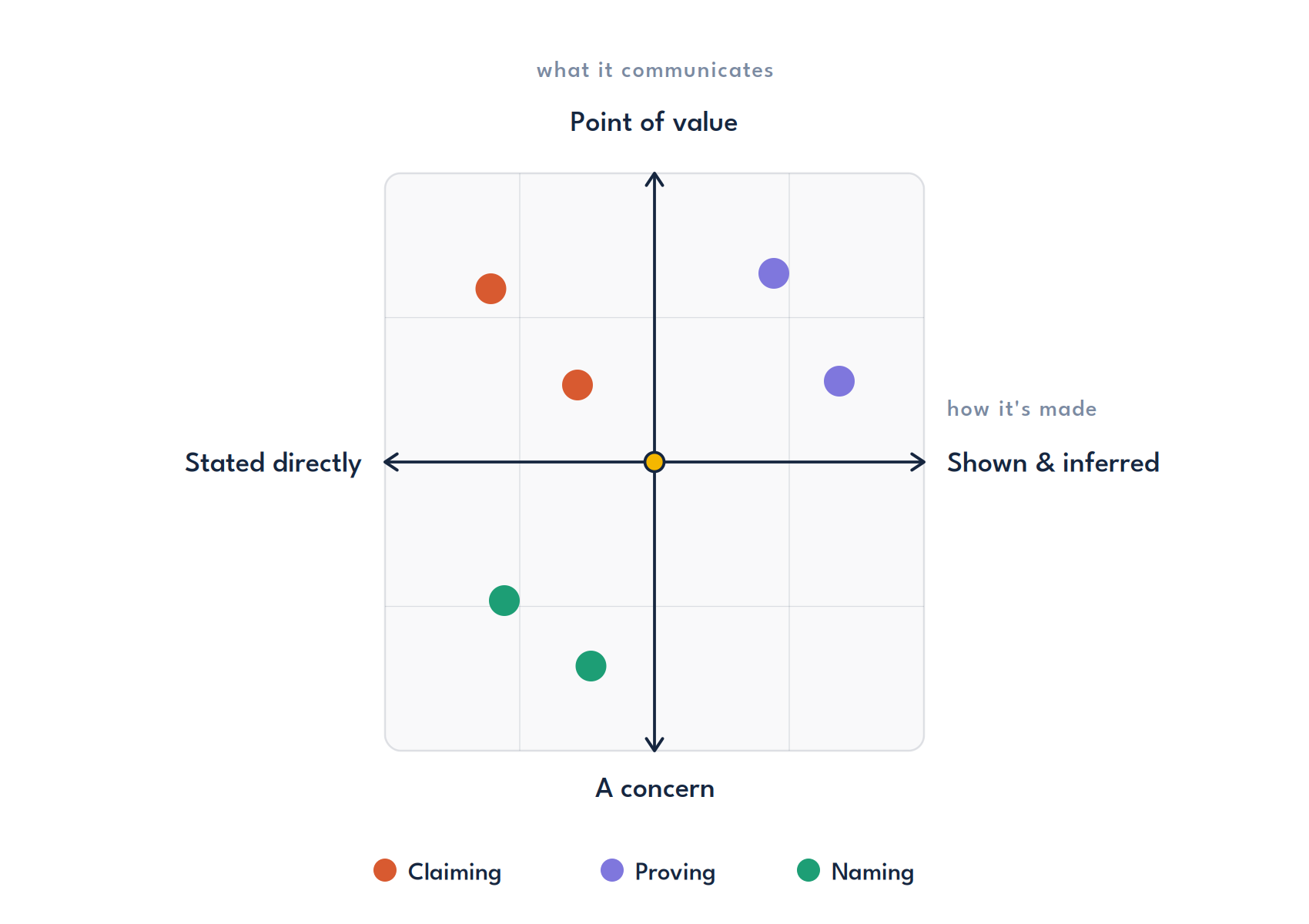
One axis looks at what the statement intends to communicate: either a point of value, or tackling a concern. The second axis concerns how the statement is made: directly (e.g. “we’re trusted in the industry”), or simply shown and left for the audience to infer.
We’ve discovered you can also code these statements into specific ‘functions’: every statement has the purpose of either ‘naming’, ‘claiming’ or ‘proving’. We colour-code each function so we can see at a glance that every statement sits where it should, and that the piece has a healthy mix of all three.
Plotting and understanding the consequence of each position a function sits within the matrix helps guarantee your message is delivered effectively.
The key is matching how you deliver a message to whoever has to ‘carry the trust’. To figure out who carries the trust, ask yourself: after this line is said, who has to do the believing?
‘Claiming’ involves asking the audience to carry that burden. It’s for statements that prospects cannot easily verify, so — if you’re lucky — they take your word and ‘credit’ trust to you. These should be used for smaller, non-critical claims.
‘Proving’ removes the burden altogether: the audience concludes it themselves from the evidence presented to them. This is integral in the age of GenAI — see my article ‘Replace Performative Authenticity with Demonstrable Authenticity’.
‘Naming’ means putting something uncomfortable in the open, such as a common criticism, and tackling it. This builds trust: by saying the thing they may have already been thinking, you show you’re not hiding it. You volunteer to carry a burden most people dodge, which creates a positive signal.
Back on our matrix, you start to see a pattern emerging with strong case studies: colours aligned into neat quadrants, no scattering. It gives you an insight into the areas of the matrix you need to occupy in order to reliably grow trust in the future.
When it comes to points of value, avoid solely stating them; leave the prospect to infer some of that, too. A good rule of thumb is to state what prospects can verify, and prove what they can’t. The top two quadrants should have an equal spread of points. Similarly, avoid stating things too aggressively so as not to appear unrealistic, since every prospect will have doubts.
When it comes to common concerns and criticisms, the opposite is true: state them as clearly as you can. The bottom right quadrant should be empty. This may seem counter-intuitive, but a) prospects are likely to unearth them anyway and this way you can tackle them on your terms, and b) the trust this charitable transparency will give you in the eyes of your prospect far outweighs any potential downsides.